

Our verdict and overall rating

Our verdict on InterServer
A useful choice for a conventional website when a short contract matters. Compare the $7 regular monthly cost with the annual offer, and bring a more frequent backup routine for changing business data.
Research-based editorial opinion. Five equally weighted criteria; no measured speed, uptime or support results and no customer-rating aggregate.
InterServer at a glance
| At a glance | Verified information |
|---|---|
| Hosting types | Standard shared, Boost, reseller, ASP.NET, VPS and dedicated servers; Standard reviewed here. |
| Starting price | $2.50 first month; regular monthly rate $7. |
| Free SSL | Yes, SSL/TLS included. |
| Control panel | DirectAdmin on the current Standard specification. |
| Resources | Unlimited storage, transfer and email under the shared-hosting acceptable-use policy. |
| Storage technology | SSD caching is advertised; this is not a claim that the entire account uses NVMe. |
| Backups | Weekly; confirm retention and restoration scope. |
| Support / migration | 24/7 support and free migration listed; confirm the exact migration scope. |
Plans, prices and renewal costs
Price snapshot: September 6, 2026. Standard web hosting · introductory billing terms · tax treatment confirmed at checkout. These are the selected offers, not every available billing option. Optional extras are excluded. Check the final tax treatment and order total before payment.
| Plan / term | Intro rate | First payment | Renewal | Key inclusions |
|---|---|---|---|---|
| Standard · monthly | $2.50/mo | $2.50 1 months | $7 per month | Same Standard service; lowest initial commitment |
| Standard · 6 months | $2.50/mo | $15.00 6 months | $42 per 6 months | Prepay six months |
| Standard · 12 months | $2.50/mo | $30.00 12 months | $84 per 12 months | Prepay one year |
| Standard · 24 months | $2.50/mo | $60.00 24 months | $168 per 24 months | Prepay two years |
What the numbers mean for your budget
At unchanged rates, taking the first-month offer and paying eleven regular months costs $79.50 in the first year. The annual introductory term costs $30, a $49.50 difference. Monthly billing is therefore a flexibility purchase, not automatically the cheapest way to keep the same site for a year. The second annual term is $84. Keep the domain, paid add-ons and independent backups outside this hosting-only calculation.
Monthly equivalents are rounded. A prepaid offer is not a month-to-month contract; first-term extras do not necessarily recur.
A budget you can compare
| Plan and market | First bill / service | Renewal | Included / check |
|---|---|---|---|
| InterServer Standard · 12 months US / USD storefront · checked 2026-09-06 | $30.00 for 12 months | $84.00 / 12 months | Prepay one year Official offer source |
| Offer | 12 months: allocated / cash | 24 months: allocated / cash | 36 months: allocated / cash |
|---|---|---|---|
| InterServer Standard · 12 months USD · 12-month first term | $30.00 / $30.00 | $114.00 / $114.00 | $198.00 / $198.00 |
We allocate the first payment across all months it covers, including any bonus months. Cash includes whole billing periods needed to reach the chosen horizon. Renewal rates are held constant for this illustration; they are not guaranteed future quotes. Unknown bills remain unverified. Domains, optional services and taxes are excluded unless explicitly added. Read the calculation method.
Adjust this offer and compare alternatives. The market, currency and verification date are labeled on each table. The screenshot below records the corresponding published offer.
Server locations and what they mean
| Region | Published locations | Scope |
|---|---|---|
| US East | Secaucus, New Jersey | Provider facilities; ask which is assigned to a new Standard account. |
| US West | Los Angeles, California | Provider facility coverage; not a guarantee of a Standard checkout choice. |
| US Central | Dallas, Texas | Published in the VPS location range; do not assume shared-plan availability. |
The facility directory and VPS location list describe different scopes. Confirm the actual origin and whether a move is supported before ordering Standard for a regional audience. A free CDN can cache eligible assets nearer visitors but cannot relocate every dynamic application request.
Check the official location information before selecting a server.
A closer look at the official offer
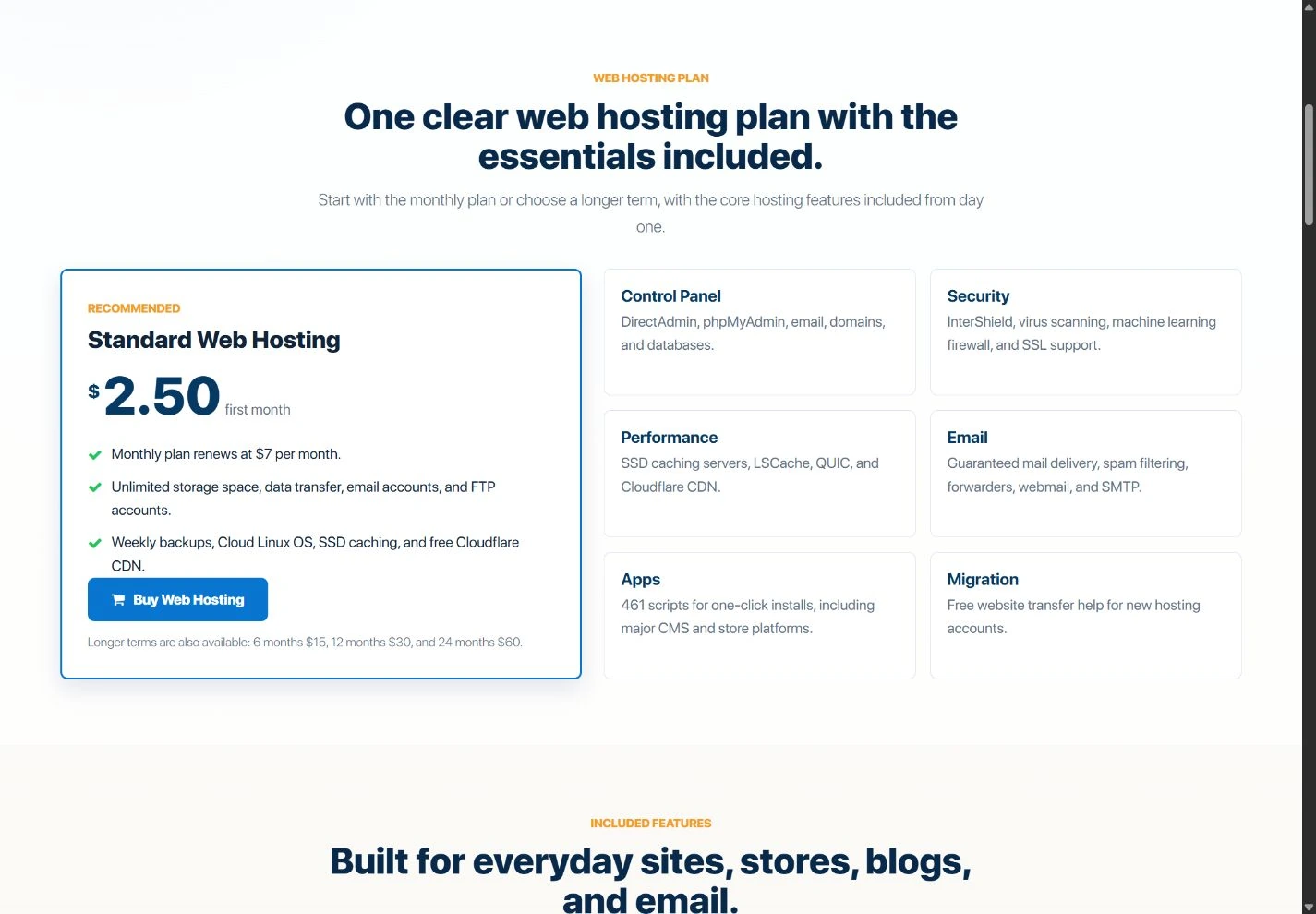
The image records a public page, not a paid customer dashboard or a test result. It may show a region-specific promotion that changes after the capture date. Our tables keep the important figures readable on a phone; use the full-size image to inspect the original context.
The value of a shorter commitment
Many hosting promotions advertise a low monthly equivalent while requiring several years of payment upfront. That arrangement can suit an established project, but it is less comfortable when you are testing an idea or deciding whether a migration is worthwhile.
InterServer’s Standard hosting documentation explicitly describes a monthly plan. The potential benefit is flexibility: you can evaluate the service without assuming a long prepaid term. The trade-off is that a shorter billing cycle can have a different effective rate, so compare the exact current invoice.
Reasons to consider it
- A monthly-plan route that is relevant to uncertain or changing projects.
- A detailed official specification covering the dashboard and developer tools.
- A conventional shared-hosting model for common website applications.
Reasons to look elsewhere
- Unmetered storage and transfer remain bounded by acceptable use and shared resources.
- Weekly backups alone may be insufficient for frequently changing data.
- Older descriptions of the dashboard can be inconsistent with the current Standard specification.
A flexible contract is valuable only if the website can actually leave. Keep your own copies of the site and database, understand the domain’s ownership and retain access to any external services. Billing flexibility and technical portability are separate requirements.
Read the current dashboard and runtime specification
The official Standard technical table checked for this review lists DirectAdmin, weekly backups, SSH access and scheduled jobs. The wider site also references cPanel products, which is why you should confirm the exact package rather than infer the dashboard from the brand.
| Requirement | Why to check it | Evidence to request |
|---|---|---|
| Control panel | Migration instructions and team training depend on it. | The panel included in your new Standard account. |
| Runtime version | Application compatibility is more precise than a language name. | Supported current versions and whether you can select them. |
| Scheduled work | Imports and maintenance jobs need predictable execution. | Cron availability and process or execution limits. |
| Resource pressure | Shared hosting can throttle work before storage is full. | How to view usage and what triggers intervention. |
The technical table includes historical language-version references alongside newer ones. A version appearing in a list does not make it an appropriate choice for a new deployment. Check your application’s current requirements, choose a maintained compatible version and ask for clarification if the documentation mixes old and current options.
For a Node.js or other nontraditional shared-hosting workload, verify the production support status, process lifetime and deployment model. Do not assume a listed language means the account behaves like a general-purpose server.
Compare the real monthly bill
The current Standard pricing page provides a complete comparison: $2.50 for the first month and $7 per regular month, or $30 for an introductory annual term and $84 per annual renewal. These are distinct billing choices for the same Standard offer.
A monthly plan suits a project that might close or move soon. If the full year is already required, the introductory annual term is cheaper. The table above shows the initial and repeat charges for six-, twelve- and twenty-four-month commitments too.
Write down the product name before comparing another promotion. A Standard account, Boost package, ASP.NET plan and VPS can have different resource and management terms. A claim about one product should not be carried into another cart.
Use the cost calculator to compare the same period of use. Include domain renewal, independent backup storage and any migration work that is outside the included service.
Unlimited is a usage policy, not infinite capacity
A shared server has finite CPU, memory, storage performance and concurrent process capacity. “Unlimited” website slots or “unmetered” transfer can simplify commercial packaging, but neither removes those physical and operational constraints.
A hundred dormant websites and one busy application create very different loads. Ask how the service measures resource use, what happens when your account reaches a limit and whether an upgrade changes the constrained resource. Do not wait until a campaign produces a traffic spike to learn the answer.
Also check whether backups, media archives or unrelated downloads are allowed in the hosting account. A shared hosting plan should not be assumed to replace a general cloud-storage service. Keep off-site copies in a service intended for that purpose.
If a website is slow, identify the bottleneck first. Large images, database queries, third-party scripts and remote API calls can produce very different fixes. Buying additional capacity without diagnosis can increase the bill while leaving the user experience unchanged.
Weekly backup: decide how much data can be lost
The current Standard specification lists weekly backups. Ask how long those copies are retained, whether they include the complete account and how recovery works. A weekly schedule is not automatically suitable for a shop, booking system or membership site that receives new data every day.
Plan around the most valuable information. Rebuilding a cached image may be inconvenient; losing a week of orders is a business problem. If you add a more frequent database backup, make sure it is usable with the matching files and configuration.
Store a recovery copy outside the InterServer account and test it on a private destination. Document who can retrieve it and how to restore the site if the main account is unavailable. A recovery process should not depend on an email inbox that fails with the same hosting account.
A practical evaluation before you settle in
- Confirm the plan name, panel, renewal price and supported runtime in writing.
- Move a representative copy of the site and check the features your business actually uses.
- Test forms, mail delivery, scheduled jobs, redirects and administrator access.
- Record resource usage and repeat a normal maintenance cycle.
- Take an independent backup and prove that it can be restored.
- Compare the ongoing work with your previous host, not just a speed-test screenshot.
We have not independently benchmarked InterServer uptime, speed or support. Treat the first period as your opportunity to establish how the service behaves with your workload. Avoid aggressive shared-server load tests without provider permission.
Alternatives and our verdict
Namecheap: compare its annual shared-hosting option if cPanel is important and a one-year commitment is acceptable. Examine the backup tier carefully.
Hostinger: compare its integrated setup if you are comfortable prepaying a longer term. Put the total upfront cash beside the monthly alternative.
eUKhost: consider its UK cPanel range for a primarily British audience and compare location and support requirements.
InterServer’s place on a shortlist is flexibility, with the usual shared-hosting questions still to answer. Choose the current product based on documented requirements. An old low-price claim or an inherited cPanel description should not decide a new purchase.
Check InterServer plans (affiliate link, opens in a new tab)How we reached the rating
| Criterion · 20% each | Score / 5 | Why it received this score |
|---|---|---|
| Value and commitment | 4.5 | A genuine monthly route reduces commitment; the annual introduction is cheaper if a full year is already needed. |
| Included features | 4.0 | Standard includes SSL, email and migration, subject to shared-hosting usage limits. |
| Backup and recovery | 3.0 | Weekly provider backups leave a larger recovery gap than daily copies; retention needs confirmation. |
| Administration and support options | 3.5 | DirectAdmin and conventional application tools are documented, but older cPanel descriptions can confuse migrations. |
| Pricing and documentation clarity | 4.0 | The current pricing page separates initial and repeat charges for several billing terms. |
Overall: (4.5 + 4.0 + 3.0 + 3.5 + 4.0) ÷ 5 = 3.8/5, rounded to one decimal. Scores reflect the documented offer and its fit for the reader described in our verdict. A small score difference should not override an essential requirement.
Scale: 1 = substantial documented limitations; 2 = limited fit or evidence; 3 = adequate with material trade-offs; 4 = strong documented fit; 5 = exceptionally complete in this coverage set. Half-points express an intermediate judgment. Missing information lowers confidence or documentation scores, not an invented measurement of service quality. Full rating methodology.
Compare the next decision
Hostinger vs InterServer: prepayment, flexibility and recovery
Compare Hostinger Premium with InterServer Standard for a conventional website, including actual monthly and annual billing.
Month-to-month web hosting: pay for flexibility deliberately
Find verified monthly billing in our partner coverage and see why a monthly-equivalent headline is not a monthly contract.
Namecheap vs InterServer: small sites and billing choices
Compare cPanel-based Namecheap with current DirectAdmin-based InterServer Standard, including backups and recurring costs.
Best hosting for multiple websites: plan for 3 or 10 sites
Compare eligible hosting tiers for three or ten websites, with shared capacity, backup needs and full-term costs.
Best web hosting for a small business: budget for keeping it running
Choose among our hosting partners by email, recovery, administration and predictable ongoing costs for a company website.
Best WordPress hosting: choose the maintenance workflow
Compare documented WordPress hosting features, staging and backup limits, with a practical update-and-recovery checklist.
Frequently asked questions
Does InterServer Standard use cPanel?
The current Standard technical specification checked for this review lists DirectAdmin. InterServer also references cPanel products, so verify the exact package in your order.
Does unmetered hosting support any workload?
No. Shared resources and acceptable-use policies still apply. Confirm the limits relevant to CPU, memory, processes and the intended use of storage.
Are weekly backups enough?
That depends on how much new data you can lose. Frequently changing transactional data generally needs a more frequent recovery strategy.
How much does Standard cost after the introduction?
The checked offer lists $7 per regular month or $84 for an annual renewal. The introductory monthly payment is $2.50 and the introductory annual payment is $30, before optional extras and applicable tax.
Sources & editorial notes
Sources checked on September 6, 2026. Product details can change by country, platform and billing term. Prices shown are snapshots, not live quotes.
- InterServer: captured Standard billing options
- InterServer: Standard technical specification
- InterServer: provider facilities
- InterServer: VPS-specific locations
- www.interserver.net · official plans and billing evidence
This guide combines published documentation with our editorial analysis. We have not measured provider performance or conducted an independent security audit. Read our methodology. Report a correction.

About the author
Vlastimil Stich
Vlastimil founded HostingRanker in 2020. His work spans 3D graphics, entrepreneurship and investing, with close to 100 web projects created during his business career. He writes about hosting, website infrastructure and the practical decisions behind building and maintaining a website.