

Our verdict and overall rating
Our verdict on Private Internet Access
A strong household candidate when the device limit would otherwise be a problem. The annual plan avoids a three-year commitment, while the configurable apps reward a careful platform-by-platform check.
Research-based editorial opinion. Five equally weighted criteria; no measured speed, uptime or support results and no customer-rating aggregate.
Private Internet Access at a glance
| At a glance | Verified information |
|---|---|
| Service types | Consumer VPN; antivirus and dedicated IP are optional paid add-ons. |
| Starting price | $79 for 39 months, then $79 per 36 months; annual option $47.88 per year. USD, before applicable tax. |
| Simultaneous devices | Unlimited compatible connections under the subscription terms. |
| Protocols | WireGuard and OpenVPN, depending on platform. |
| Server coverage | 91 countries and all 50 US states advertised. |
| Provider base | United States; the privacy policy identifies PIA Private Internet Access, Inc. |
| Privacy evidence | Open-source apps; third Deloitte assessment announced in the 2025 audit article. |
| Free plan / refund | No permanent free tier here; 30-day guarantee for new direct subscribers, with app-store exceptions. |
| Support | 24/7 support; we have not measured resolution quality. |
Plans, prices and renewal costs
Price snapshot: September 7, 2026. Direct USD offer · exact $79 long-plan first payment checked in the public order summary. These are the selected offers, not every available billing option. Optional extras are excluded. Check the final tax treatment and order total before payment.
| Plan / term | Intro rate | First payment | Renewal | Key inclusions |
|---|---|---|---|---|
| 1 month | $11.95/mo | $11.95 1 months | $11.95 per month | VPN with unlimited simultaneous device connections. |
| 1 year | $3.99/mo | $47.88 12 months | $47.88 per year | VPN with unlimited simultaneous device connections. |
| 3 years + 3 months | $2.03/mo | $79.00 39 months | $79.00 per 36 months | VPN with unlimited simultaneous device connections. |
What the numbers mean for your budget
The public USD order summary shows $79 for the initial 39 months. Multiplying the rounded $2.03 headline by 39 would produce $79.17, so our table uses the observed total instead. Renewal is $79 for 36 months, about $2.19 per month. The annual alternative costs $47.88 and may suit an uncertain need better, even though the long introduction adds 27 months for $31.12 more upfront. Optional antivirus and dedicated IP are excluded from these figures.
Monthly equivalents are rounded. A prepaid offer is not a month-to-month contract; first-term extras do not necessarily recur.
A budget you can compare
| Plan and market | First bill / service | Renewal | Included / check |
|---|---|---|---|
| Private Internet Access VPN · 3 years + 3 months US / USD storefront · checked 2026-09-07 | $79.00 for 39 months Includes 3 bonus months | $79.00 / 36 months | VPN with unlimited simultaneous device connections. Official offer source |
| Offer | 12 months: allocated / cash | 24 months: allocated / cash | 36 months: allocated / cash |
|---|---|---|---|
| Private Internet Access VPN · 3 years + 3 months USD · 39-month first term | $24.31 / $79.00 27 service months remain after the horizon | $48.62 / $79.00 15 service months remain after the horizon | $72.92 / $79.00 3 service months remain after the horizon |
We allocate the first payment across all months it covers, including any bonus months. Cash includes whole billing periods needed to reach the chosen horizon. Renewal rates are held constant for this illustration; they are not guaranteed future quotes. Unknown bills remain unverified. Domains, optional services and taxes are excluded unless explicitly added. Read the calculation method.
Adjust this offer and compare alternatives. The market, currency and verification date are labeled on each table. The screenshot below records the corresponding published offer.
Server locations and what they mean
| Region | Published locations | Scope |
|---|---|---|
| North America | All 50 US states; Canada | State availability is useful when a particular US destination matters. |
| Europe / other Americas | Examples: United Kingdom, Germany, Netherlands, Brazil | Representative countries from the provider directory. |
| Asia Pacific | Examples: Japan, Singapore, Australia; virtual India and Indonesia entries | The directory explains virtual India routing through Singapore/UK and Indonesia through Singapore. |
These are examples, not the complete 91-country list. The advertised IP country can differ from physical hardware placement. The directory also warns that some available locations may be absent during updates. Confirm the actual app choice when a particular city or state is essential.
Check the official location information before selecting a server.
A closer look at the official offer
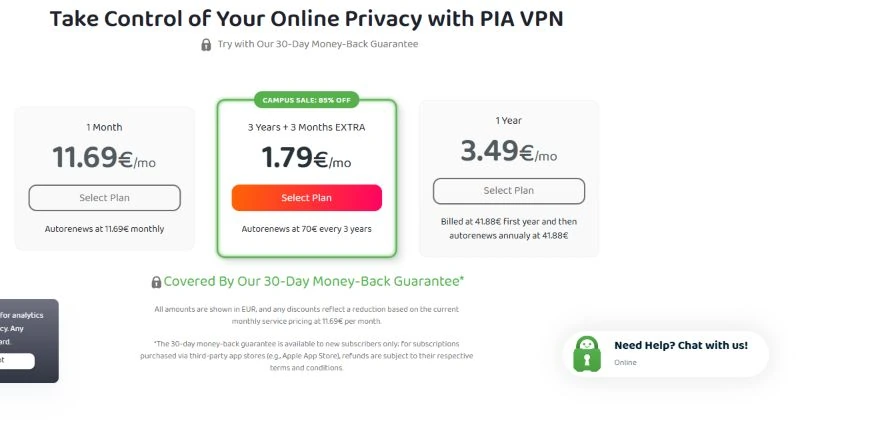
The image records a public page, not a paid customer dashboard or a test result. It may show a region-specific promotion that changes after the capture date. Our tables keep the important figures readable on a phone; use the full-size image to inspect the original context.
Why the device allowance matters
A household can exceed a VPN device limit faster than expected: phones, laptops, tablets and a television may all be active at once. Private Internet Access, often shortened to PIA, states that it allows unlimited simultaneous connections on compatible devices with one subscription.
That removes one type of constraint. It does not guarantee a native app for every piece of equipment, identical settings across operating systems or a particular connection speed. Make a device inventory before choosing the service.
Reasons to consider it
- Unlimited simultaneous connections on compatible devices.
- Published configuration guidance for desktop routing and disconnect protection.
- An annual pricing option that can be compared with longer promotional commitments.
Reasons to look elsewhere
- Advanced settings create more opportunities to exclude traffic unintentionally.
- Feature behavior and availability vary by operating system.
- An unlimited allowance should not be confused with business administration or unrestricted redistribution.
PIA is particularly relevant when connection count is the reason another candidate does not fit. If you only need one laptop, the allowance is less important than usability, documented privacy practices and performance on your own network.
Plan a household setup before configuring every device
Start with the devices used for important daily tasks. Install the official applications, enable suitable defaults and verify normal browsing. Once those work, decide how to handle equipment without a supported native app.
| Question | Why it matters | Practical approach |
|---|---|---|
| Which devices need their own app? | Separate apps allow individual control and diagnosis. | Start with personal computers and phones. |
| Which devices depend on a router? | A router changes the route for several users at once. | Check exact model support and keep a recovery path. |
| Which local services must still work? | Printers, casting and local storage may use separate network paths. | Test access after enabling the VPN. |
| Who maintains the setup? | Settings and applications change over time. | Keep a short device and configuration record. |
Do not share the primary account casually across unrelated people. The service’s current account terms still apply, and a consumer plan does not create the user-management controls a business might require.
For a shared household router, make the effect visible to everyone who relies on it. If a payment site or work application refuses a VPN route, know how to diagnose and narrow the exception without disabling protection for every device unnecessarily.
Split tunneling: a useful tool with a boundary
PIA publishes documentation for split tunneling and kill-switch settings. Split tunneling allows selected applications or destinations to follow a different route, where supported. That can solve compatibility problems, but it also makes the configuration harder to reason about.
Use the smallest exception that solves the issue. If a local application must connect directly, exclude that application rather than an entire browser used for unrelated activity. Check whether associated helper processes and DNS requests follow the same intended rule.
After changing a rule, test both sides: an application expected to use the tunnel and one expected to bypass it. Repeat after a major application or operating-system update. A successful test before an update is not a permanent guarantee.
Disconnect protection has its own settings and failure cases. Read the current client guidance for your platform and verify the behavior with harmless traffic. We have not independently validated every PIA platform.
Cost: compare the annual option with the long promotion
The USD offer checked on September 7, 2026 lists an annual option at $47.88 for the first year, equivalent to $3.99 per month, with the same stated annual renewal. It also shows monthly and longer promotional options. Your country, currency and the current promotion may change the checkout.
A long plan can reduce the displayed monthly equivalent while increasing the cash at risk if your needs change. Extra introductory months also mean the renewal period may not match the initial period. Write down the total and duration of each rather than comparing only the rounded monthly figures.
Check any add-on separately. A dedicated address or another optional service should meet a specific need; it is not automatically required for ordinary browsing. Include applicable taxes and confirm the purchase channel’s cancellation and refund process.
Evaluate the service promptly using your actual household setup. The point of an evaluation period is to discover a limitation before the long-term purchase becomes a sunk cost.
Open-source claims and what they establish
PIA states that its applications and used VPN protocols are open source. Public code can make scrutiny possible. It does not mean that every user has audited the code, that every future version has been assessed or that production operations are fully described by the client source.
We have not independently audited PIA or verified its operational privacy controls. If a security review is central to your decision, inspect the actual report, its date, the tested version and the systems in scope. Distinguish a provider’s summary from the underlying evidence.
Regardless of provider, a VPN does not remove account-based identification or make a compromised device safe. Keep browser and operating-system updates current, use unique passwords and avoid treating an IP change as complete anonymity.
For privacy needs involving a specific threat, identify the adversary and the information you want to protect before choosing the tool. Ordinary household convenience and high-risk communications are different decision contexts.
Evaluate the connection without a misleading speed score
We have not run a controlled PIA performance benchmark. To evaluate your own setup, record the base connection, device, app version, protocol and server location. Test a nearby route first and compare it with the same task without the VPN.
Measure more than a peak download result. Check a call, a normal download, a laptop wake cycle and a device switching networks. Note whether a problem is repeatable and whether it affects one application or all traffic.
Test the intended split-tunneling and disconnect settings with non-sensitive activity. A public IP page only observes the request it receives; it does not establish how every background application is routed. Use the VPN setup checklist as a structured starting point.
If a configuration fails, return to the known-good baseline. Making several changes at once can produce a working connection without a clear understanding of which traffic is now outside the tunnel.
Alternatives and our verdict
CyberGhost VPN: compare it for a more guided consumer route if seven simultaneous connections are enough.
NordVPN: compare it for a ten-device household and check the current supported features on your operating systems.
Proton VPN: consider Free for one-device evaluation or Plus for a paid alternative with a different feature set.
PIA is a practical candidate when connection count or configurable routing is a real requirement. Its value depends on using those controls correctly. Read CyberGhost vs PIA to compare the household decision without turning provider marketing into a performance claim.
Check PIA plans (affiliate link, opens in a new tab)How we reached the rating
| Criterion · 20% each | Score / 5 | Why it received this score |
|---|---|---|
| Value and commitment | 4.5 | The long offer has a modest upfront total and the annual alternative is clearly priced. |
| VPN features | 4.5 | Configurable apps, routing features and an optional dedicated IP suit users with specific requirements. |
| Privacy evidence | 4.0 | Open-source apps and a provider-announced third Deloitte assessment add evidence; this is not our own audit. |
| Devices and app coverage | 4.5 | Unlimited simultaneous connections are particularly useful for a household with many compatible devices. |
| Pricing and documentation clarity | 4.0 | Renewal terms are visible; the exact long-plan total needs the order summary because the monthly figure is rounded. |
Overall: (4.5 + 4.5 + 4.0 + 4.5 + 4.0) ÷ 5 = 4.3/5, rounded to one decimal. Scores reflect the documented offer and its fit for the reader described in our verdict. A small score difference should not override an essential requirement.
Scale: 1 = substantial documented limitations; 2 = limited fit or evidence; 3 = adequate with material trade-offs; 4 = strong documented fit; 5 = exceptionally complete in this coverage set. Half-points express an intermediate judgment. Missing information lowers confidence or documentation scores, not an invented measurement of service quality. Full rating methodology.
Compare the next decision
NordVPN vs Private Internet Access: devices and the full bill
Compare NordVPN and PIA using a matched EUR budget, app-specific features and the number of devices you need.
Best VPN for multiple devices: match the whole household
Build a VPN shortlist for 1, 5, 7, 10 or more concurrent connections, with platform limits and household costs in view.
Proton VPN vs Private Internet Access: choose the useful differences
Compare Free, Plus and PIA by simultaneous devices, platform-specific options, public privacy evidence and commitment.
Another option for your requirements
For another unlimited-connection option, read our Surfshark review. Its security bundles have separate device and platform limits, and it does not offer port forwarding. Compare the features you need before choosing by the introductory price.
Frequently asked questions
Does PIA limit simultaneous devices?
The official page checked for this review advertises unlimited simultaneous connections on compatible devices. Current account terms and platform support still apply.
Is split tunneling automatically safer?
No. It creates routing exceptions. Use it for a defined need and verify which applications and DNS requests bypass the tunnel.
Does open source mean the service has no security risks?
No. Public source supports scrutiny but does not prove every version or production system is free of vulnerabilities or operational risks.
Is the annual price a permanent guarantee?
No. The cited annual price and renewal are a dated offer snapshot. Confirm your own checkout and renewal terms before purchasing.
Sources & editorial notes
USD pricing and the public offer screenshot were checked on September 7, 2026. Other product documentation was checked on September 6, 2026. Prices are dated observations; check the final billing and tax terms before purchase.
- PIA: device allowance, pricing and open-source statements
- PIA: split-tunneling overview
- PIA: current client settings
- PIA: desktop split-tunneling instructions
- PIA: captured USD plans and renewal terms USD offer and original screenshot checked September 7, 2026.
- PIA: country list and virtual location notes
- PIA: third Deloitte audit announcement
- PIA: operating entity and privacy policy
- www.privateinternetaccess.com · official plans and billing evidence
This guide combines published documentation with our editorial analysis. We have not measured provider performance or conducted an independent security audit. Read our methodology. Report a correction.

About the author
Pavel Stich
Pavel is a co-founder of HostingRanker with a focus on SEO and copywriting for the technology and financial sectors. His interest in early-stage businesses informs his practical approach to software: understand the problem, examine the trade-offs and choose tools that support a sustainable business.